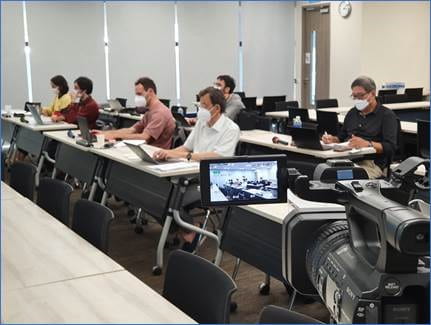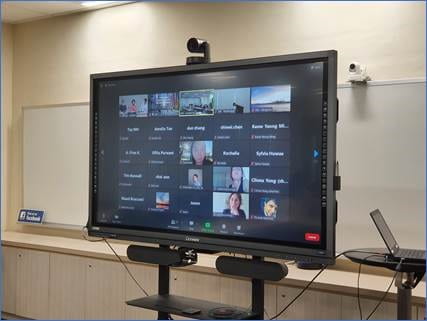
A 3 days hybrid-mode International Conference (Governing Diverse Cities in Europe and Asia) organized and hosted by the Asia Research Institute was held from 9th to 11th May 2022. This International Conference had 6 discussion panels spread over the 3 days with a total of 17 presenters with 9 presenting online and 8 presenting on-site. A total of 180 online participants and 62 In-person participants attended this International Conference.
CIT’s IT Share Services Team (ITSS) provided technical and logistics support to ensure a very successful, effective and immersive conference was conducted.
Dear Henry
“I believe my workshop is the first which worked on a hybrid mode. In such instances the challenge is either to cater to the zoom audience or the in person audience.
ARI’s setup managed to cater to both primarily because of a person managed zoom camera which allowed those in the room asking questions to be captured and shown in the zoom mode. When this feature is not present zoom audiences may hear the question but they do not see the person. This feature in my opinion made the difference because it allowed the zoom audience to see.
As always the events team is very efficient moving between the zoom questions and those in the room.
The organizers did a brilliant job and one of the Paris participants said this was one of the best organized event he has been to.”Assoc Prof Kong Chong Ho
Yale-NUS College & Department of Sociology
National University of Singapore
For an effective and immersive conference, CIT’s ITSS team deployed a 3 camera approach to provide sufficient video coverage of presenters, moderators and audiences who were live on-site and to the virtual viewers in real time. With adjustments and additional equipment, the team addressed some of the common issues faced when conducting hybrid events such as presenter is inaccessible to the microphone, no video coverage of on-site participants and video is not panning to the person asking questions during Q&A discussion. More information on the equipment layout is shown in the diagram below.

For more information on how CIT ITSS team managed the technical and logistic support for this event, please contact Mr. Henry Kwan (henrykwan@nus.edu.sg)
Here are more photos taken during the event: