Call for Philosophy Peer Mentors

Dear fellow philosophy majors,

Hope you’ve settled into Week 3. We wish to invite you to join us as peer mentors in this semester’s continuation of the philosophy essay-writing peer mentoring project!

Last semester, our project broke the inertia against student-run academic activities in our major. The need for a platform for mutual sharing and learning was heartfelt and urgent. New students of philosophy, many from outside our department/faculty, are often thrown off course by the demands of a philosophy term paper. Philosophy’s introduction module no longer demands weekly summaries, so new majors embark on higher-level modules with less writing experience. Experienced writers get stuck on tried-and-tested styles of writing without actively seeking the benefit of peer perspectives and criticism. Graduate TAs are overworked and cannot be expected to coach too many disciples.

Even more importantly, our major is small and has the potential to be much more close-knit. Stereotypically, our major houses isolated individuals who take too long to get to know each other. What better way to ameliorate this situation than to tackle (rant about) writing together! New friendships to be formed, and people to feel less alone in intellectual pursuit – let our programme be a stepping-stone towards that end.

Our professors have been extremely supportive, and FASS has recently commended our project via the FASS Student Leadership Award. We’d like you to join our collective will to grow our project into a sustainable and far-reaching one.

This semester, we envision our sessions in the following manner:
–        Stage 1a, where basic (informal) logic is introduced to first-timers: several sessions to run starting around week 5.
–        Stage 1b, where the demands of philosophy essay-writing are introduced to first-timers: several sessions to run starting around week 5.
–        Stage 2, where participants gather to share their past graded essays for mutual peer criticism, guided by mentors familiar in the particular module/topic. This will happen on a rolling basis, based on mentor availability and registration through a Google Form or similar system.

Scheduling is flexible, and mentors’ comfort and availability are our first priority. Let’s talk and get to know each other if we haven’t already, and then find a mutually favourable fit. Let us know by email if you’d like to join us, mentioning:
–        Which stage(s) of the project you are interested in (feel free to elaborate)
–        Your year of study, roughly how many philosophy modules you have taken, and at what levels
–        (For Stage 2) Which philosophical sub-domains (ethics, epistemology, etc) you are interested to facilitate peer criticism in
–        Your mobile contact details, if you’re okay sharing

Please RSVP to nusphilopeermentoring@gmail.com . Hope to hear from you by Friday 26th August!

Best,
Will Zhang, Ivan Lee, Edison Oh, Rachael Yap, Tan Si En
Screen Shot 2016-08-25 at 06.55.35Screen Shot 2016-08-25 at 06.56.30

“Torture and Imprisonment” by Owen Schaefer

In most legal regimes, imprisonment is the primary means of criminal sanction, while punitive torture is prohibited.  However, I argue that the same moral reasons that ground prohibitions on torture are also reasons to oppose punitive imprisonment.  Prison, especially long sentences, can involve as much or more suffering as torture. Moreover, both involve intentional degradation, dehumanization and a cruel use of the threat of suffering to induce compliance.  Some have used this line of reasoning to argue for the permissibility of mild forms of torture (i.e., corporal punishment) in the criminal justice system.  I propose that we should instead accept the arguments against torture as sound; punitive imprisonment is, like torture, inhumane and therefore impermissible.  This implies the need for significant reforms to criminal justice systems, and we need to urgently investigate alternatives to imprisonment such as reconciliation models of justice.  Some non-punitive use of imprisonment (such as sequestration of acutely dangerous individuals, where inducement of suffering is not intended) may still be justifiable, but still prisons would have to be significantly reformed – perhaps along the public health model of quarantine.

Philosophy Seminar Series
Date: Thursday, 25 August 2016
Time: 2pm – 4pm
Venue: AS3 #05-23
Speaker: Owen Schaefer
Moderator: Dr Qu Hsueh Ming

About the Speaker:

Owen Schaefer is a Research Fellow at NUS’s Centre for Biomedical Ethics under the MOH-funded initiative, Clinical Ethics Network + Research Ethics Support (CENTRES).  He first began working in applied ethics as a ‘pre-doctoral’ fellow at the Department of Bioethics at the National Institutes of Health in the US.  He received his DPhil degree in philosophy at Oxford in 2014, writing a dissertation on moral enhancement.  Immediately prior to joining CBmE, he spent a year as a post-doc at the Oxford Centre for Neuroethics researching the implications of various novel biotechnologies.  His research interests cover a wide array of topics in applied ethics, including research ethics, enhancement, punishment, neuroethics, stem cell studies, synthetic meat, and assisted reproduction.

“Newton’s Modal Metaphysics and his Polemics with Spinozism” by Prof Eric Schliesser

In this paper I explore a series of terse arguments by Newton in the General Scholium of the Principia. All these arguments involve unusual modal metaphysics. I analyze the metaphysical commitments revealed by these arguments and by drawing on writings of Toland and Clarke I argue that Spinozism is the implied target.

Philosophy Seminar Series
Date: Thursday, 18 August 2016
Time: 2pm – 4pm
Venue: AS3 #05-23
Speaker: Prof Eric Schliesser
Moderator: Dr Qu Hsueh Ming

About the Speaker:

Eric Schliesser (PhD, Chicago 2002) is Professor of Political Theory at The University of Amsterdam, and Visiting Professor of Philosophy & Moral Sciences, Ghent University. He publishes in early modern philosophy and the philosophy of economics. He is an active blogger, and has edited numerous volumes, most recently, “Sympathy: A History of a Concept” (Oxford). His monograph on Adam Smith is forthcoming with Oxford University Press.

Professor Tagore’s Visit to Shaoxing

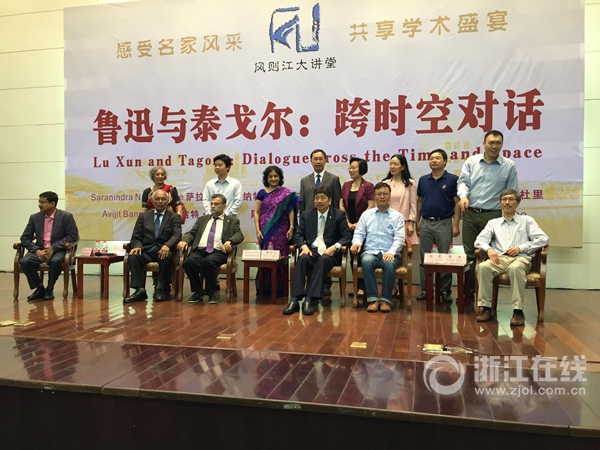
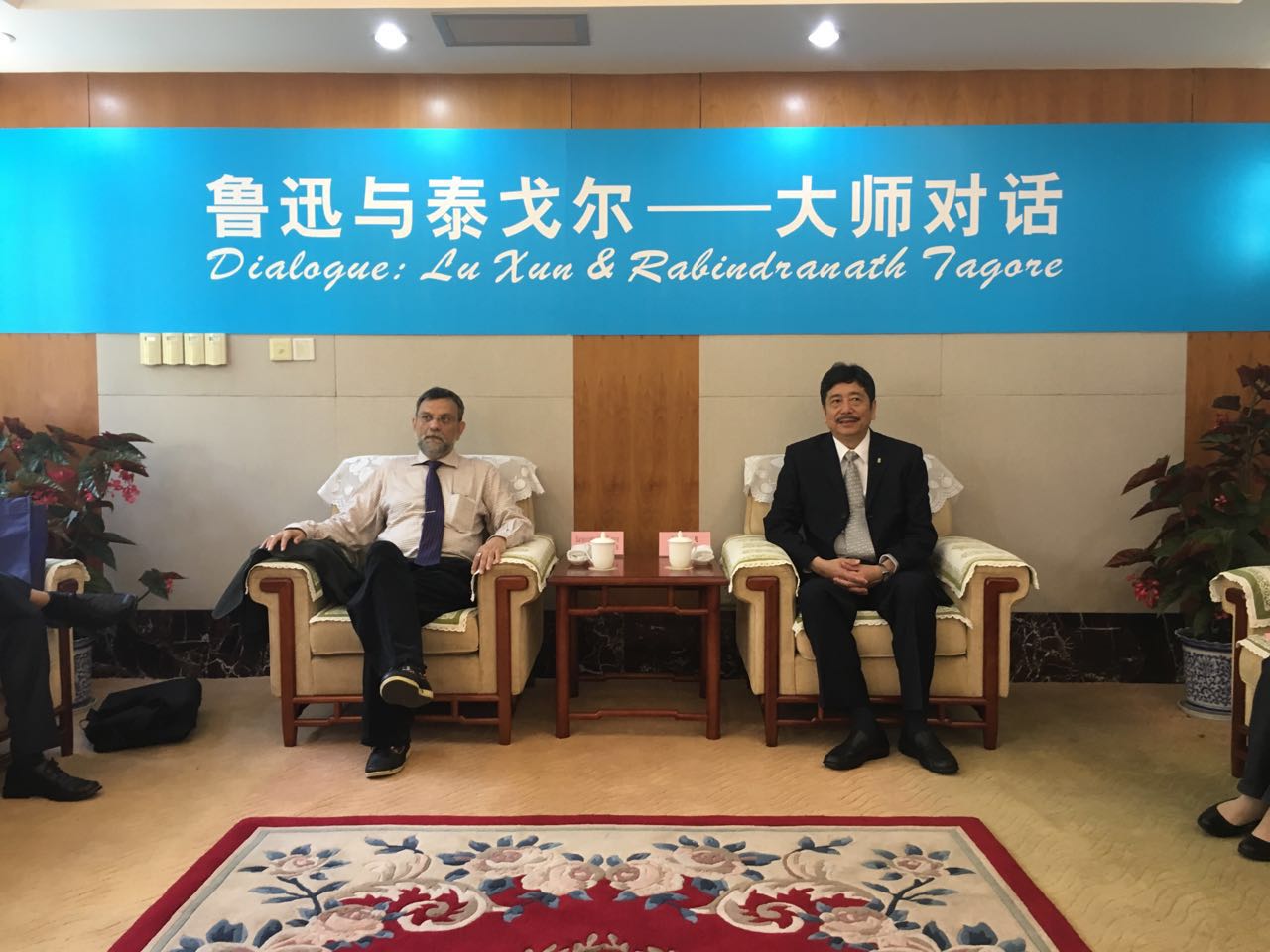
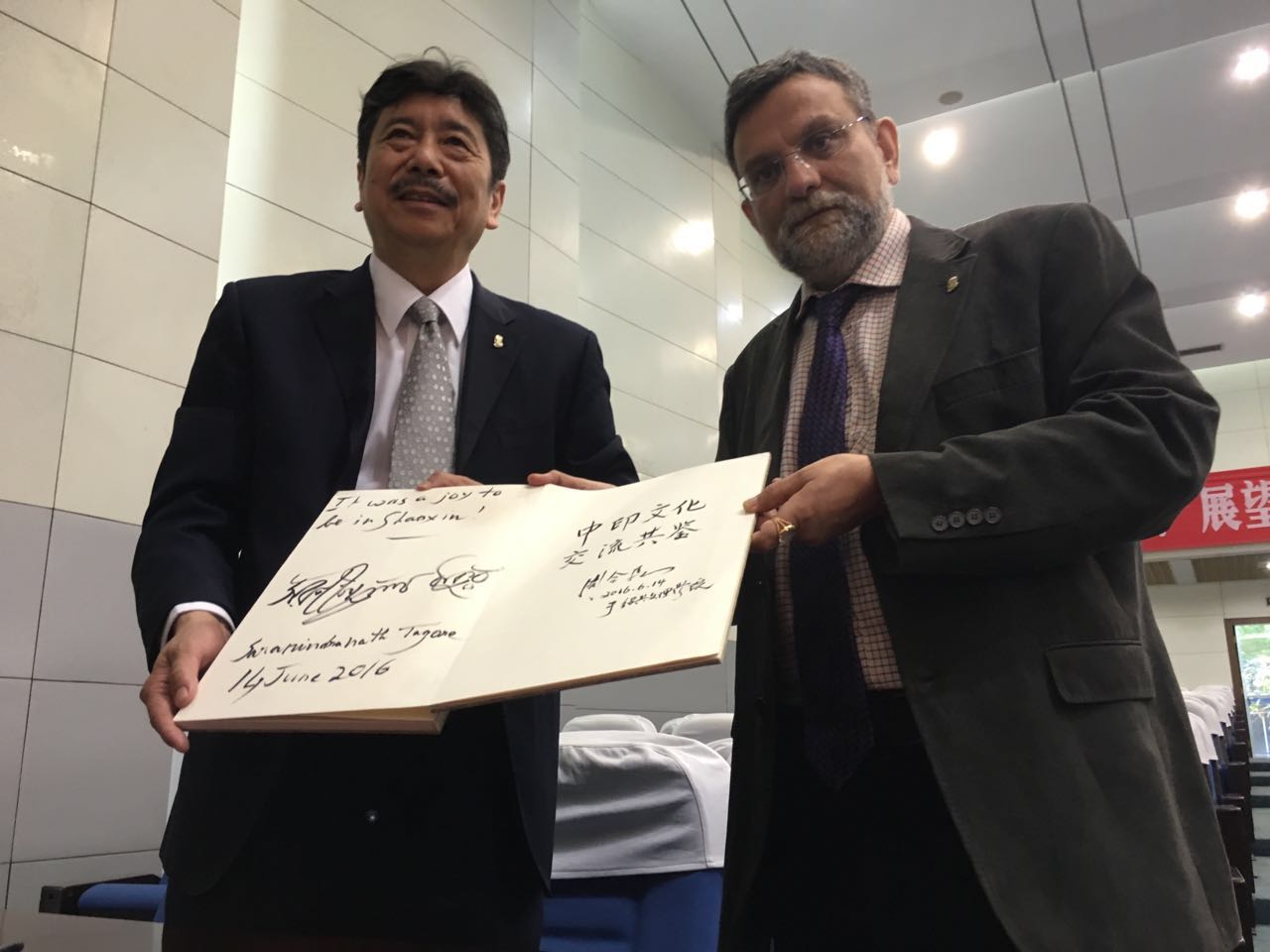
Prof SN Tagore Visit to Shaoxing Photo5On 14th June 2016, our very own A/P Saranindranath Tagore from the Department of Philosophy was invited by the Lu Xun Cultural Foundation and the Indian Consulate in Shanghai to visit Shao Xing University for the event, “Lu Xun and Tagore: A Dialogue Beyond Time and Space” (鲁迅与泰戈尔:跨时空对话).

As two of the greatest literary giants in the 20th Century, Lu Xun and Rabindranath Tagore need no introduction. What is little known, however, is the latter’s admiration of China and the Chinese culture, as well as the respect Lu Xun harbored for his work. It is a real shame that across his multiple visits to China in the 1920s, Tagore never had a chance to formally meet and converse with Lu. After almost 90 years, this wrong is finally made right as Prof Tagore, representing his great grand uncle, met the grandson of Lu Xun, Mr Zhou Ling Fei, who now serves as the Deputy Chairman of the Lu Xun Cultural Foundation. Prof Tagore’s presence at this dialogue was hence also a commemoration and recreation of Tagore’s 1920s China visits.

Prof SN Tagore Visit to Shaoxing Photo3Prof Tagore was joined by eminent Tagore scholar Dr Indra Nath Choudhuri, Dr Sanghamitra Basu of Indira Gandhi National Centre, and Dr Avijit Banerjee of Cheena Bhavan (The Institute of Chinese Language and Culture, founded by Rabindranath Tagore himself). These delegates commented on the popularity of Lu Xun’s works, especially his novels, in India, as well as Tagore’s love of Chinese culture. Similarly, Mr Zhou Ling Fei and delegates from China commented on the popularity of Tagore’s poems in China and Lu Xun’s deep and profound respect for Tagore’s works. Zhou explained that while millions of Chinese marveled at the literary brilliance of Tagore’s poem, Lu Xun, whose own work dwelled on similar themes and reflected similar sensitivities, was able to see deeper into Tagore’s thought and ideas.

CProf SN Tagore Visit to Shaoxing Photo4ommenting on the two great writers, Prof Tagore strongly believes that Lu Xun and Tagore are artists that will stand the test of time, and he has no doubt that as long as human civilization persists, their works will be passed on and read by countless generations. Going beyond the two literary giants Lu Xun and Tagore, the delegates from both India and China emphasized the importance of continuing the healthy cultural exchange between the two Asian nations.

Prof SN Tagore Visit to Shaoxing Photo1Please see the following media coverage of Prof Tagore’s visit.

1 Report by Consulate General of India in Shanghai
2 Report by Press Trust of India
3 Report by India TV
4 杭州日报 Report
5 浙江在线 Report
6 浙江日报 Report
7 浙江日报 Report 2
8 新华网 Report
9 钱江晚报(杭州) ReportProf SN Tagore Visit to Shaoxing Photo2
10 中国新闻网 Report
11 东方教育时报 Report

12 新蓝网/浙江网络广播电视台 Report
13 光明网 Report
14 Other Online Reports
15 Shaoxing University Report

(Prepared by Jeremy Huang with input from A/P Loy Hui Chieh)

To all our grad students doing Asian/Chinese philosophy

Call for Applications to the Tan Ean Kiam Chinese Philosophy Graduate Award

To encourage students interested in pursuing graduate studies in Chinese philosophy, the Kongzi Cultural Fund is calling for applicants to their Tan Ean Kiam Chinese Philosophy Graduate Award. The conditions are as follows:

  1. Full time graduate student (MA or PhD) who is pursuing research in Chinese philosophy may apply.
  2. Singapore Citizens, Permanent Residents or non-Resident who is a full time graduate student enrolled in one of the local universities (NUS, NTU, SMU) may apply.
  3. Singapore Citizens and Permanent Residents who are pursuing graduate studies in an overseas university may also apply.
  4. Each award ranges from 4,000-6,000SGD; the size will depend on the number of applicants and other factors. The total fund available per year for the awards is 30,000SGD.
  5. Applicants should submit an English CV, personal statement in both English and Chinese, two recommendation letters, transcripts and other relevant documents proving status as graduate student.
  6. The Kongzi Cultural Fund will be responsible for forming a committee, to see to the selection and interview process; the number of awardees per year may vary according to circumstances.
  7. The awards will be given out each year on the 27th Day of the 8th month in the Chinese calendar (i.e., September or October) at the Annual Birthday Celebration of Confucius hosted by the Nanyang Confucian Association, by representatives of the Kongzi Cultural Fund and Tan Ean Kiam Foundation.

Yale-NUS Philosophy Talk: Iakovos Vasiliou (CUNY) on Friday, 12 August, 2:30 p.m

Happy mid-July, Singapore philosophers!

Here’s a brief “save the date” for an event happening early this upcoming semester: Prof. Iakovos Vasiliou (City University of New York) will be giving a talk entitled “Rethinking Eudaimonism.”

When?: Friday, 12 August 2016, 2:30-4:30 p.m. Where?: East Core Board Room (EC-03-08), Yale-NUS College

Here is a link to the Yale-NUS campus map: https://www.yale-nus.edu.sg/about/campus-map/. East Core is highlighted in light purple. To get to the board room, enter through the library and walk up the stairs.

We look forward to seeing you there.

ISPD (2016): Philosophy and Science

4899e4ab-598b-4de9-813c-d50de61a165cFrom data privacy to artificial intelligence, to the ethics of experimentation–today’s scientific and technological advancement confronts core issues about our human identity and values. Against this background, philosophy promises to empower us with clear and critical thinking to make sense of our scientific present and future. That’s why “there’s no better way to spend a Saturday morning!” than to enable teenagers in philosophical discussion about science at the Inter-school Philosophy Dialogue (ISPD), said keynote speaker Assistant Professor Voo Teck Chuan of the Centre for Biomedical Ethics (CBmE), Yong Loo Lin School of Medicine.

039eb102-dbc2-4711-a208-158b7b8a92b7This year’s ISPD was held at Raffles Girls School (RGS) on July 9. It saw the participation of some 147 students from fourteen secondary schools from across Singapore, joining with scores of facilitators to discuss various topics on philosophy and science. This is the 13th ISPD, and for the first time, the event was jointly organised by the Philosophy Departments of Raffles Girls School and Raffles Institution, with the sponsorship of the Department of Philosophy at NUS.

Continue reading

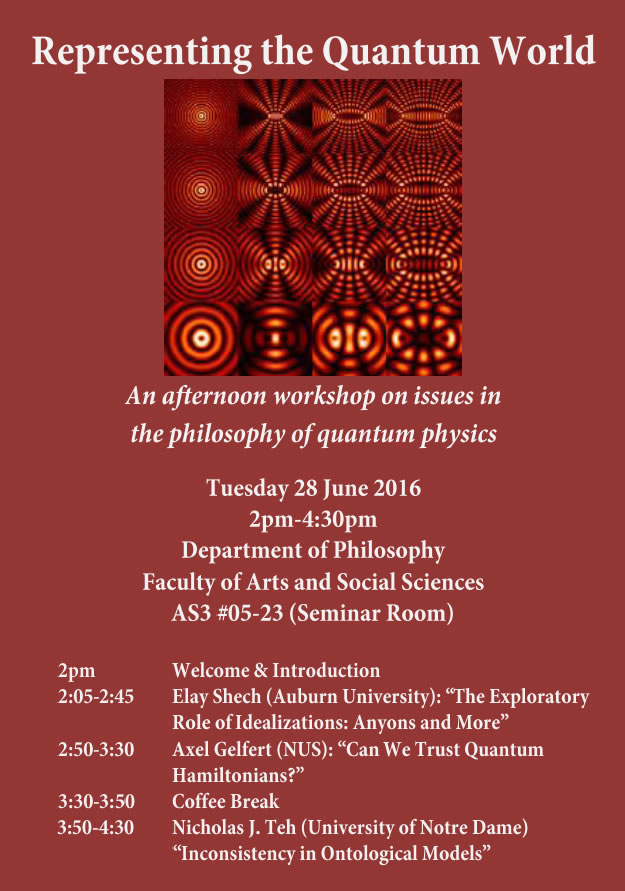
“Idealizations, Essential Self-Adjointness, and Minimal Model Explanation in the Aharonov-Bohm Effect” by Dr Elay Shech

Two approaches to understanding the idealizations that arise in the Aharonov-Bohm (AB) effect are presented. It is argued that the standard topological approach, which takes the non-simply connected electron configuration space to be an essential element in the explanation and understanding of the effect, is flawed. An alternative approach is outlined. Consequently, it is shown that the existence and uniqueness of self-adjoint extensions of symmetric operators in quantum mechanics have important implications for philosophical issues. Also, the alleged indispensable explanatory role of said idealizations is examined via a minimal model explanatory scheme.

Philosophy Seminar Series
Date: Thursday, 30 June 2016
Time: 2pm – 4pm
Venue: AS3 #05-23
Speaker: Dr Elay Shech
Moderator: A/P Axel Gelfert

About the Speaker:

Dr Elay Shech is an Assistant Professor at Auburn University, Alabama, and is currently an Isaac Mannaseh Meyer Fellow in the Department of Philosophy at NUS. His work primarily concerns the nature and role of idealizations and representations in the sciences and, more specifically, in condensed matter physics. His work has appeared journals such as Foundations of Physics, Synthese, and Philosophy of Science.