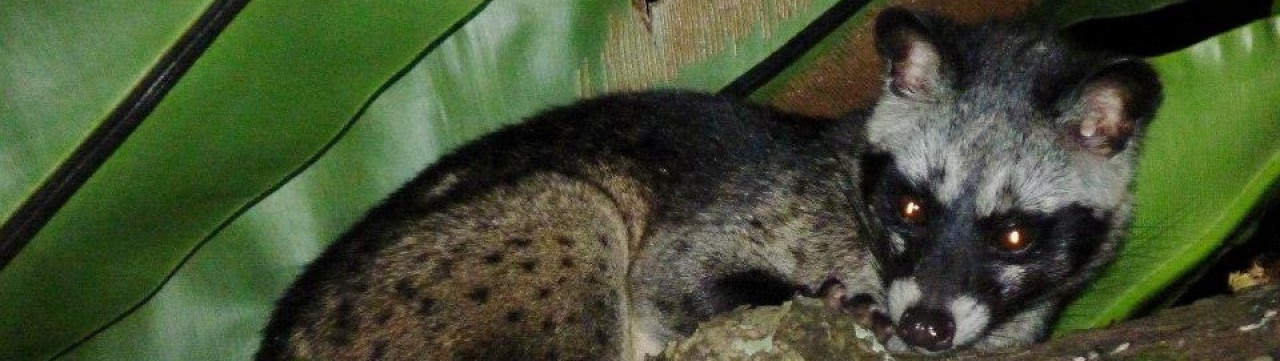
 Hi guys! I’m Claudia, the NUS Civet Research Team’s new intern. I’m tasked with managing NCRT’s social media accounts with the objective of creating awareness through online platforms and also through talks, roadshows, and presentations. The job has been great so far, and I’ve learnt so much not only about Singapore’s common palm civets, but also the local biodiversity as well.
Just an introduction about me. I’m an NTU Philosophy major, but at the same time I’ve always had an interest in animal science and wildlife conservation. I came across the NCRT’s internship opening on Facebook, and I didn’t think twice about applying for it. I had my reservations – I wasn’t sure if I was what they needed. Afterall, at that point of applying, I was only in my first year of studies in a completely unrelated subject. However, I’m fortunate to have had experience in education and conservation work with ACRES, and also research work with horses while I was in Australia.
Being alongside the team is nothing short of an honour. These are the people who pioneered civet research work in Singapore, and we wouldn’t know as much about the local civets as we do now if not for them. Once, I went civet tracking with Tze Kwan on Pulau Ubin. It was a hot day and she had in her bagpack a load of heavy tools and tracking equipment. Despite the heat and the difficulty of locating the elusive civets, she still kept going on the grassy slopes and rocky terrain. She covers large areas in Pulau Ubin at least once a week, every week as part of her field work. I went home in full admiration of her dedication and perseverance.


(Photos: Tze Kwan Fung, Gladys Chua)
In the past two months as an intern, I have helped with events such as Ubin Day and the Festival of Biodiversity. Events like these are important opportunities for us to reach out to the public to inculcate awareness and appreciation for the civets. I have always been driven by the starfish story, you know, the one where the boy picks up starfish on the shore and returns them back into the sea, and a passing old man stops to question him about what he is doing and tries to tell him that it wouldn’t make a difference because there are just too many washed up starfish. The boy then tells him that, at least, he’s made a difference to each and every starfish which he has returned back into the sea. I see my work as something like that. It’s a luxury to know that for each person we talk to, we are informing that one person so that he or she can in turn make more informed decisions in the future. It is hard work, sometimes exhausting, but it has a strange kind of comfort – like a pat on the back, which brings a smile on my face. Our social media platforms are just as important, allowing us to reach a larger audience within a short span of time.

(Ubin Day volunteers. Photo: U Volunteers)
We are now in the midst of preparing for a campaign which we are excited to reveal very soon (watch this space!). We are also getting ready for a series of talks that will take place in the coming few months. If you’d like us to present at your school or organization, click on the Research and Campaigns lightbulb icon on the right. We’ll be more than happy to hear from you.
Till next time.

