“Angry Civet Cat” of Project 365 Sketches by Ivan Chew

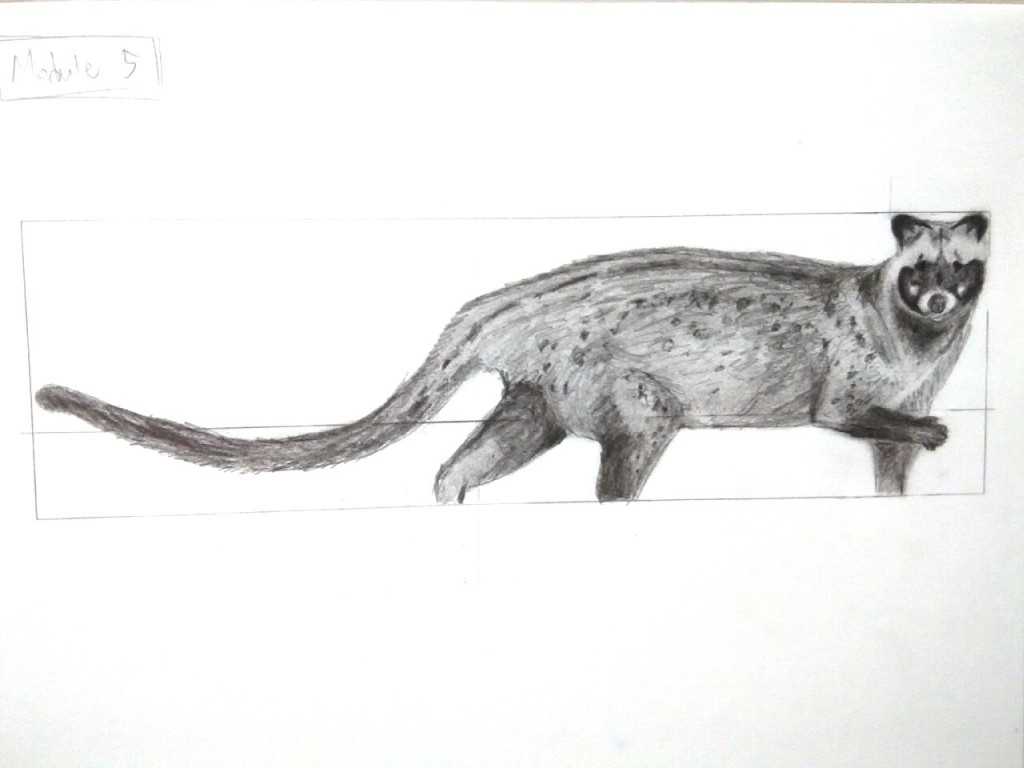
Ivan Chew aka The Rambling Librarian sketches the “Angry Civet Cat” (#143: Project 365 Sketches) for his cute Angry Animal series this week!


Ivan wrote,

“Angry Civet Cat” (#143: Project 365 Sketches) 2013, Wed 23 May. As I was looking up Civet Cat pictures, I couldn’t help but associate those cute faces with Raccoons. Must be the black band across their eyes. Here’s an angry Civet Cat, looking indignant because of unscrupulous practices in harvesting “civet cat coffee”. #365sketches [CC-BY]“

Indeed, some members of the public have mistaken the common palm civet as the raccoon as they both have the characteristic eye masks across their eyes. We would then remind them that we do not have raccoons in Singapore and share some of the differences between the two animals! The common palm civet has three stripes along its back, spots on its sides and a long black tail which is as long as its body, sometimes with a white tip. Interestingly, although these two animals are found in different geographical locations, and are hardly related except that they are both in the Order Carnivora, both animals have managed to adapt to urban areas and thus face conflict issues with humans.

With the popularisation of Kopi Luwak (coffee made from coffee beans in civet poop), civet poop coffee may be threatening wild species of civets in the region. There have been increasing concerns regarding this trade as wild civets are being captured from wild, placed in small cages (civet farms), and are fed with coffee cherries only so that they excrete coffee beans used to make Kopi Luwak.

While fortunately, we do not have civet farms in Singapore, the common palm civet still faces other threats such as trapping, loss of habitats, being killed by dogs and being hit by cars. Hopefully, more people will embrace this native urban survivor, along with many of our other amazing wildlife, and we will have happy animals and people living in Singapore!

Do check out the many other drawings Ivan did as part of his Project 365 Sketches at http://myrightbrain.wordpress.com/.

Thank you Ivan for this awesome sketch!

Print Friendly

The story of a Sri Lanka civet rescue

We recently received a query from Tusita, who has found a baby civet which was only palm-sized, excluding its tail, in Sri Lanka. The baby has just opened its eyes and Tusita has been feeding it milk several times a day and he even had to wake up at 4 am to feed the hungry baby! Tusita asked how would one know when to start feeding the baby civet fruit pulp such as papaya and apples, so we shared that baby civets generally start to take fruits when their eyes are opened.

According to Tusita, he and his dog found the civet baby through its loud calls and saw it lying at the foot of a large tree in the morning . He estimated that the nest would have been at least 10m tall and was amazed that it survived the fall. He quickly took it away for fear that a dog, macaque, mongoose or even a snake would get to it. For this same reason, he felt that putting the baby back to where it was at night was not feasible due to the presence of other animals, so he will be taking care of it until it is ready to be released back to the wild.

Civet Cat 1

Check out the baby’s white-tipped tail, and the three stripes on its back, a typical characteristic of the common palm civet. It is starting to have its characteristic black facial appearance too!

Palm Cat 1

We are glad that Tusita is providing care for this young baby and is dedicated to raising and returning it to the wild. We hope you will grow up strong and healthy, cute little fella!

Print Friendly

Tags: ,

Common palm civet mum to the rescue!

We received a sighting record from Jenna who had a wonderful encounter with a civet mum and two babies right at her own home at 6:30am in the morning! Here we share her photographs that captured the amazing interactions of this civet family.

Common palm civets spotted!

A watchful mum. The common palm civet is a solitary animal except when the mum has babies.

Look at how agile the civet mum was!

It seemed like civet mum wanted her babies to leave the window grilles.

The young ones had some difficulty climbing back onto the roof, so mum came to their rescue!

Jenna told us that after about 15 mins, they finally managed to climb up and onto the other roof. How glad we were to hear that mum saved the day!

Common palm civets are highly skilled climbers and they are often found in trees in the wild. The urban civets such as this family have adapted to living in urban spaces and have learnt to utilise structures such as drains, electric wires and roofs to travel to different places. They love to eat fruits such as mangoes and rambutans so they may drop by a home garden occasionally. Sometimes, a pregnant civet mum may also raise her little family in the roof spaces. They are active at night and are generally shy but sadly, not everyone is willing to share a home with these animals.

Their climbing abilities never fail to amaze us!

This civet family is lucky to have met Jenna, who accepted their presence readily. When asked if we could share her photos on this blog, she replied, “Please go ahead and use the photos as you wish. I am excited to be part of this as I love animals too.”

Our last wild urban native carnivore

This is heartening to hear and hopefully, more people will appreciate the existence of our native carnivore like Jenna does. What can be more exciting than to be able to enjoy wildlife in our own backyard!

Thank you Jenna for this lovely sighting and her friend, Pei Yan for encouraging her to do so.

Please share your sightings of the common palm civets with us at mammal@sivasothi.com.

Print Friendly

Tags:

Common palm civet seen at UTown NUS

It was the start of the recess week on the 25th February 2013, and this would usually be a sleepy and uneventful break during the university semester.

However, this was not an ordinary start to the break as I woke up with a Facebook status tag from one of our graduate student, Anuj Jain on an encounter with a common palm civet in University Town, right in our own campus. During the encounter, Anuj was with some of his friends. He mentioned that after the civet noticed them, it quickly ran into the pepper plant undergrowth at Town Green and then climbed up onto the Angsana tree for a few minutes.

Fortunately for us, Avinash Bahirvani, one of Anuj’s friend managed to capture some photographs of this elusive, nocturnal animal within NUS.

Are you looking at me?

The common palm civet is an adept tree climber and can skilfully maneuver around tree branches

The civet is different from a domestic cat. It has a very long tail and a masked facial pattern similar to that of a bandit.

Every year, there are several sightings of common palm civets at different localities around campus. However, most of the time, we only know of their presence through the appearance of scats the next morning. Civets mainly move around at night and often shy away from humans, hence, they are rarely spotted.

536040 10151181813516260 1545383303 n

A neat pile of civet scat consisting mainly of fishtail palm seeds along Kent Ridge Road (Photo by Koh Choon Yen)

The common palm civet is the last wild native carnivore that has managed to survive urbanisation and can co-exist with humans in urban areas. Therefore, it is really great to see the photographs of this individual in campus. We definitely hope to see them around more often. Now that you know what a civet looks like, if you spot them around your hall during your late night activity, do share this news with us at this link.

Print Friendly

Tags:

Civet shopping at CBD?

A common palm civet was spotted in Tanjong Pagar area on the 29th Nov 2012.

According to the STOMP article (30 Nov 2012), the first sighting of this civet was at 11am at Tanjong Pagar Plaza. After which, there was another sighting at Craig Road at 2.30pm.

30 Nov 2012  STOMP Civet

This second article posted a few days later, 02 Dec 2012, mentioned that the civet was caught after two attempts at the Agri-Veterinary Authority of Singapore (AVA).

02 Dec 2012 STOMP  Civet

It is not known how the civet got to Tanjong Pagar area, was the civet from a nearby forest patch that just happened to wander into our Central Business District (CBD)? Nonetheless, if you see a civet in the future, please let us know by reporting the sighting here. If this is a rescue case, please contact ACRES for help, the wildlife rescue unit is available 24/7 and can be reached at +65 9783 7782.

Print Friendly

Alexandra civet seen again… this time in daytime!

The Alexandra civet has been spotted again! Just a few days after it was first spotted, this time around, it was sighted in broad daylight. The civet was using the trees and even the buildings to explore the surroundings.

Civet on tree

Civet on building

Here is a video of the civet running along the ledge of the building hurriedly.

Special thanks to Lum Shin Si for sending the photos and the video!

Print Friendly

Tags:

Sylvia & Zipper the rescued common palm civets

Since a year ago, the civet team has already started to observe documentation of successful common palm civet rescue cases in Singapore.  The common palm civet is one of our many native wildlife and it can be found in both forested and urban environments. The life of an urban civet is however no easy feat, especially when they face threats such as being trapped. Fortunately, some of these trapped civets are given a new lease of life due to the effort of the 24-hour wildlife rescue work by ACRES and we have previously blogged about cases handled by ACRES as well. Even though this is an old post, dated back to August 2011 but it is always encouraging to see successful rescue cases.

ACRES - Rescued civet

In May 2011, Zipper, another rescued common palm civet was featured as the rescue story of the month!

Zipper the civet (ACRES)

Even though the common palm civet might be shy and secretive in nature, they can still be found in our backyards and even co-exist with us. They are one of our last wild native animals left in Singapore, so let’s treasure and appreciate them.

Print Friendly

Tags: , , , ,

Seen & Heard in Singapore – Island Ecologies Today and in Time of William Farquhar at the National Museum of Singapore!

The William Farquhar Collection of Natural History Drawings at the Goh Seng Choo Gallery, National Museum of Singapore’s sixth permanent gallery, has recently been rotated and is now open to the public!

This exhibition, “Seen & Heard in Singapore: Island Ecologies Today and in the Time of William Farquhar” featuring a selection of paintings commissioned by Singapore’s first Resident and Commandant, is guest curated by Assistant Prof Lucy Davis from School of Art, Design and Media, NTU. The exhibition is organised into six interesting themes which the public may relate to as this selection of beautiful watercolour drawings, each carefully chosen, aims to feature Singapore’s biodiversity today and at the same time highlight those that we have lost since Farquhar’s time. Special effort was also put in to include audio and visual aspects such as bird song recordings, a taxidermised common palm civet (on loan from the Raffles Museum of Biodiversity Research) and Together Again (Wood:Cut) – an animation video by guest curator Lucy. These definitely add an extra touch to the exhibition!

Image005

Themes of the exhibition awaiting your exploration:

  • Birdsong in the Time of Farquhar – featuring birds present in William Farquhar’s time and today.
  • No Animal is an Island – featuring the common palm civet and its relationship with several plant and animal species.
  • Secrets of the Forest – featuring our charismatic yet little know local forest flora and fauna.
  • Muddy Beginnings – featuring animals and plants denizens in our mangroves.
  • The City of Palms – featuring a variety of palms in Singapore.
  • Together Again (Wood:Cut) – An animation film by Lucy, featuring elements from the collection

We are also happy to mention that Lucy has kindly invited us to share about the biology and ecology of the common palm civet based on the research we have conducted on this last wild urban native carnivore in the past two years. A few of our civet photographs and those kindly contributed by Chan Kwok Wai were also selected to be featured. This documentation will accompany the taxidermised civet on display in the exhibition. Thank you Lucy for this excellent opportunity to raise awareness of the civet and to reach out to the public.

Photo by curator Daniel Tham (National Museum of Singapore facebook page)

Interested to find out more? Do drop by to learn more about Singapore’s amazing biodiversity, past and present, and at the same time, appreciate that we still have wildlife, even in our backyard!

Seen & Heard in Singapore: Island Ecologies Today and in the Time of William Farquhar

Date: Opens on 29 October 2012, Monday
Time: Open daily from 10am to 8pm
Admission: Free
Venue: The Goh Seng Choo Gallery, National Museum of Singapore, 93 Stamford Road, Singapore 178897 (nearest MRT station – Dhoby Ghaut/ Bras Basah; map)
Website/ Contact: www.nationalmuseum.sg / +65 6332 3659 / +65 6332 5642

Congratulations to Lucy and her team on putting this exhibition together so successfully! We will definitely make a trip down to view the exhibition!

Print Friendly

Tags: ,

Night time exploration at Alexandra Road

In October, we received a query for confirmation of the identity of this animal that was seen near Alexandra Road at 11.30pm.

IMG 1743

IMG 1744

We took a look at the photos – a masked face, a pair of glowing eye shine and a long black tail, it is a common palm civet! This lone civet was seen feeding on fruits that have dropped from the trees. We are glad that this civet still has available fruits to feed on and is comfortable to roam around freely in our urban city.

Special thanks to Lum Shin Si for the photos and for sharing this sighting with us! Do share with us if you have any mammal sightings here!

Print Friendly

Introducing the Common Palm Civet Facebook Page!

It started with a civet blog to raise awareness of our last wild urban carnivore and for a long time, we talked about the possibility of having another platform to share news and photos of civets in Singapore and sometimes from our neighbouring countries.

At the start of October 2012, we are proud to announce the Common Palm Civets of Singapore Facebook page! This is courtesy of Genevieve Yeo, who is currently studying the civet population at Portsdown. With this Facebook page, we hope to encourage the public who have seen civets in their backyards or around their neighbourhood to share their photos and sighting records.

Civet FB page

If you wish to follow up on civet news and research findings, just LIKE the page and you will receive the latest news and blog updates on your Facebook wall. Please feel free to share this news with your friends!

Lastly, we want to share with you a beautiful photo of a Portsdown civet taken by David Wells at 8am in the morning. Even though civets are mainly nocturnal, they have been known to be active at dusk and dawn. Just like this sighting, every new sighting or photo could reveal new information, as we have yet to learn all the secrets of this masked bandit!

Civet at 8am David Wells

Print Friendly

Tags: ,