Hi everyone, welcome back!
Over the past month, I uncovered the most catastrophic and conspicuous environmental ramifications of war, as directly inflicted by Weapons of Mass Destruction. However, are military arms the only liability and threat of warfare? In my next set of posts, I will be traversing through another facet of war’s environmental consequences: The Human-Driven Impacts of War, which are engendered by the post-war responses of societies, and can be categorised as long-term and indirect implications. This week, I will be examining the relationship between borders and biodiversity.
First, let’s find out what exactly borders are, and how they are related to war:
Interactive Infographic
Given the global burgeon of border walls and fences, we must seek to understand their impacts on biodiversity, urgently.
Impact on an Individual Survivability
The most basic way in which borders peril biodiversity would be the risk of mortality by barbed-wire fences. Wildlife can get entangled either by ramming into fences when visibility is poor, or in accidents when scaling them, as seen in the 0.84% death rate of Guanacos. Following ensnarement, animals can subsequently succumb to starvation, or pass via strangulation and injuries caused by persistent struggling. Apart from entanglement, another cardinal cause of death by border fences is electrocution, as seen in the 2008 passing of an Asian Elephant calf along the Indo-Nepal border.
Interactive Map
Impact on Populations
Alas, impacting the individual survivability of wildlife is only the tip of the iceberg –borders can also jeopardise entire wildlife populations.
Borders can not only cause population sizes to dwindle by cutting animals off vital resources and mates, but also disrupt long-established migratory routes and patterns, as seen through the loss of Balkan wildlife due to the Croatia-Slovenia border. Moreover, its influence on migration might even be permanent…
Impact on Species and Evolution
Zooming further out, borders can even precipitate effects on a species level, affecting their evolutionary processes.
Firstly, as explained in the video, borders can isolate wildlife populations, decreasing gene flow. A reduction of genetic diversity in populations can consequently lead to more inbreeding, therefore eroding populations and presaging the extinction of native species.
Secondly, borders can inadvertently cause allopatric speciation, due to habitat fragmentation. Habitat fragmentation is defined as ‘the process during which a large expanse of habitat is transformed into a number of smaller patches of smaller total area isolated from each other by a matrix of habitats unlike the original’; and can occur after the erection of physical borders naturally, or depending on how neighbouring states choose to develop the separated islands. Ascribed to different environments and the lack of gene flow, allopatric speciation can subsequently occur.
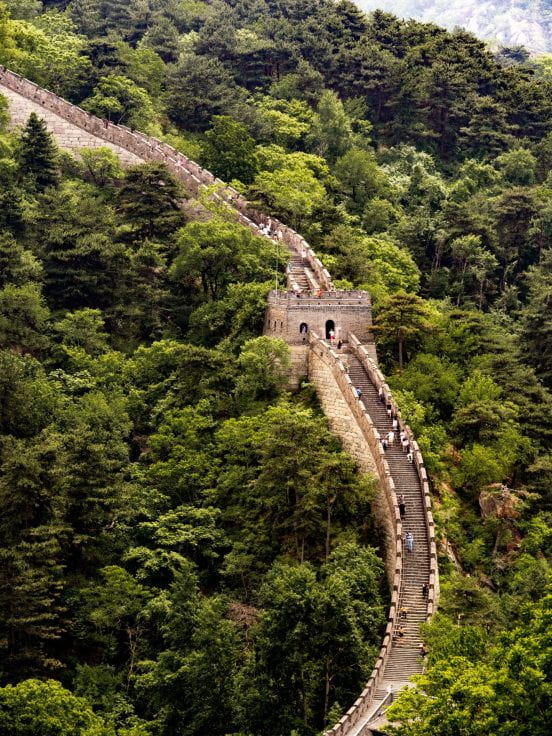
A great example demonstrating this phenomenon is the 600 year-long accumulation of genetic differences in 6 plant species along opposite sides of the Great Wall of China, each with different habitats.
Other Impacts on Physical Environment
Besides endangering animals and plants, borders can also pose significant threats to the physical environment, degrading it by increasing soil erosion, aggravating flooding and bisecting rivers.
It was definitely troubling to understand the implications of borders on biodiversity. Do you think the situation can take a positive turn if governments are better educated on this? Or do politics prevail and make this a lost cause?
“Nature knows no borders, nature knows no political boundaries”
~Sergio Avila, Wildlife Biologist
Credits: Infographics and Map made by me using Canva. Images from Pixabay and Unsplash, except top right image in interactive map (source, credit: G. Sukhchuluun)




Joanna Coleman
November 12, 2020 — 1:44 pm
Kelly,
As usual, your work is amazing.
You ask a Q at the end though, that I find a bit strange. Specifically when you say “if governments are better educated on this” ?
Among the many examples you provide, you include the southern border wall in the US. Are you suggesting that the US govt might not have at its disposal some of the world’s top scientific advisors ?
I also have a Q for you… The Great Wall of China is a globally important piece of cultural heritage (putting it mildly). Having now researched this topic, would you suggest removing / destroying parts of it to restore connectivity ?
thanks,
jc
Kelly
November 13, 2020 — 3:29 pm
Hi Dr Coleman, thank you for your comment!
So sorry for the misphrasing, I am not implying that the US government lacks access to some of the world’s leading scientific experts! In fact, some papers on the US-Mexico border I referenced were written by American scientists as advisories and warnings addressed to the government. In light of this, I would like to correct my statement to perhaps highlight the issue of governmental priorities and communication between scientific communities and the government.
Pertaining to your question on the Great Wall of China, I wouldn’t suggest removing parts of it to restore connectivity. Construction of the structure started in 770 BC, and ended in 1644. As such, the resultant biological communities have had up to 2800 years to adapt and and re-establish their ecosystem processes and cycles. I believe that modifying the now stabilised environments could result in more harm than benefit (though I admit I’m not too sure on this answer).
Thank you!