
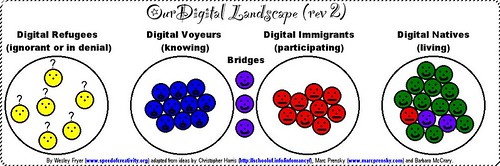
The Biomedical Multimedia Unit at the University of Melbourne has come up with a preliminary report which details first-year students' use of and engagement with technology (kudos to collegewebeditor once again).
The report has this to say about blogs:
It may be surprising to some in the University community that more than one-third of first year students have kept their own blog in the last year and well over half (57%) read others' blogs. The educational possibilities of blogs are beginning to be explored... and it is important for academics and faculties to be aware of this public form of self-publishing and online interaction.
In NUS, we have already set out to explore academic blogging with the establishment of NUS Module Blogs. However, more will need to be done to help students discover how to push the boundaries of learning with the latest tech tools. The report further points out that:
In a recent US study of undergraduate students' uses and perceptions of technology in their learning, Katz [in Caruso & Kvavik] (2005) concludes that:
'freshman students arrive at our institutions with a set of electronic core skills. Such skills include communications (telephone, email, text-messaging, and IM), Web surfing (not to be confused with research skills), word processing and video gaming... these young people can make technology work but cannot place these technologies in the service of (academic) work.' (p. 7)
It is not that first year students are incapable of using technology for specialised, context-appropriate purposes... The critical point is that while first year students might use technology in a range of ways and may, apparently, be digitally literate, we cannot assume that being a member of the 'Net Generation' is synonymous with knowing how to employ technology-based tools strategically to optimise learning experiences and outcomes in university settings.
Do Singaporean students' attitudes, skills and experiences with technology mirror their Australian and American counterparts? There is some anecdotal evidence that they will likely be similar. The challenge for educational technology departments and progressive educators is to open their eyes to the possibilities.
Original photo by Wesley Fryer from here, reproduced under a cc by-sa 2.0 license.

This post is licensed under a Creative Commons Attribution-Share Alike 2.0 License. <!-- -->
